Dual-control architecture
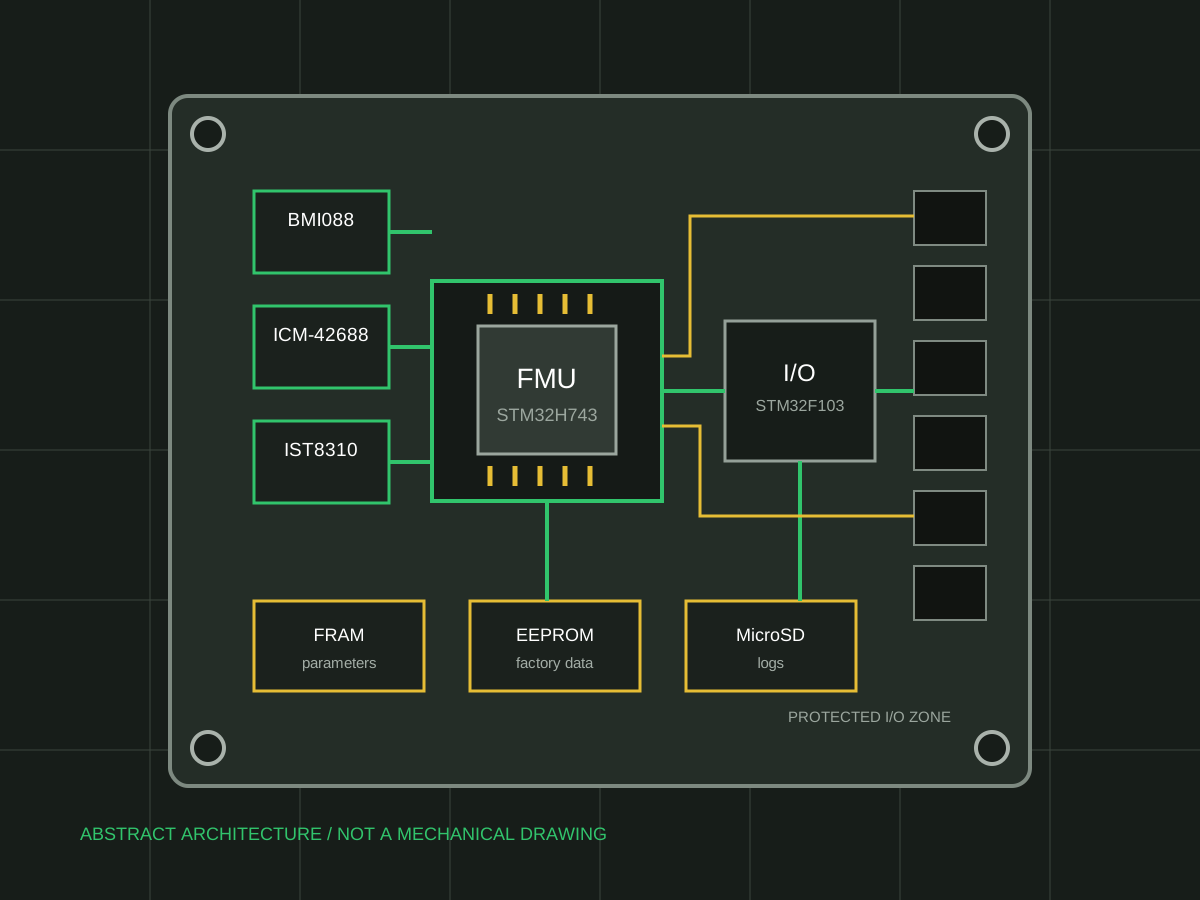
The STM32H743 main controller and STM32F103 I/O co-controller separate high-level control from I/O handling.
An autopilot control module built around redundant sensing, protected interfaces, isolated power domains, and full-board vibration control.
Core functions
The P6C architecture addresses sensing, control, storage, power integrity, I/O protection, and vibration as one system.
The STM32H743 main controller and STM32F103 I/O co-controller separate high-level control from I/O handling.
Heterogeneous dual IMUs and dual-magnetometer support give the control stack multiple sensor inputs.
More than 24 TVS/ESD devices, BQ24315 USB protection, and TDK feedthrough filtering protect external interfaces.
Internal full-PCB vibration isolation protects sensors, controllers, power domains, and communication circuitry together.
FRAM, EEPROM, and MicroSD separate operational parameters, factory data, and full-cycle logs.
Unified GH1.25 interfaces use IDC locking latches, with independent programming access for both controllers.
Hardware configuration
Dedicated processing and I/O domains combine with multiple sensor, storage, and protection layers.
Interfaces and integration
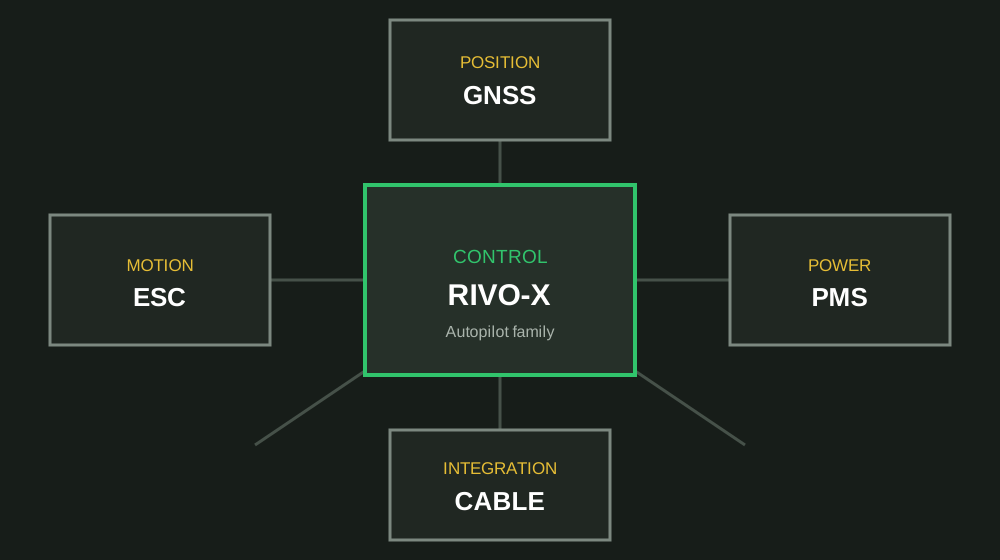
Unified GH1.25 interfaces with IDC locking latches support secure integration. Independent programming interfaces serve the main and co-controller.
Electrical and environment
Specifications below come from the updated RIVO-X technical documentation.
Universal platform applications
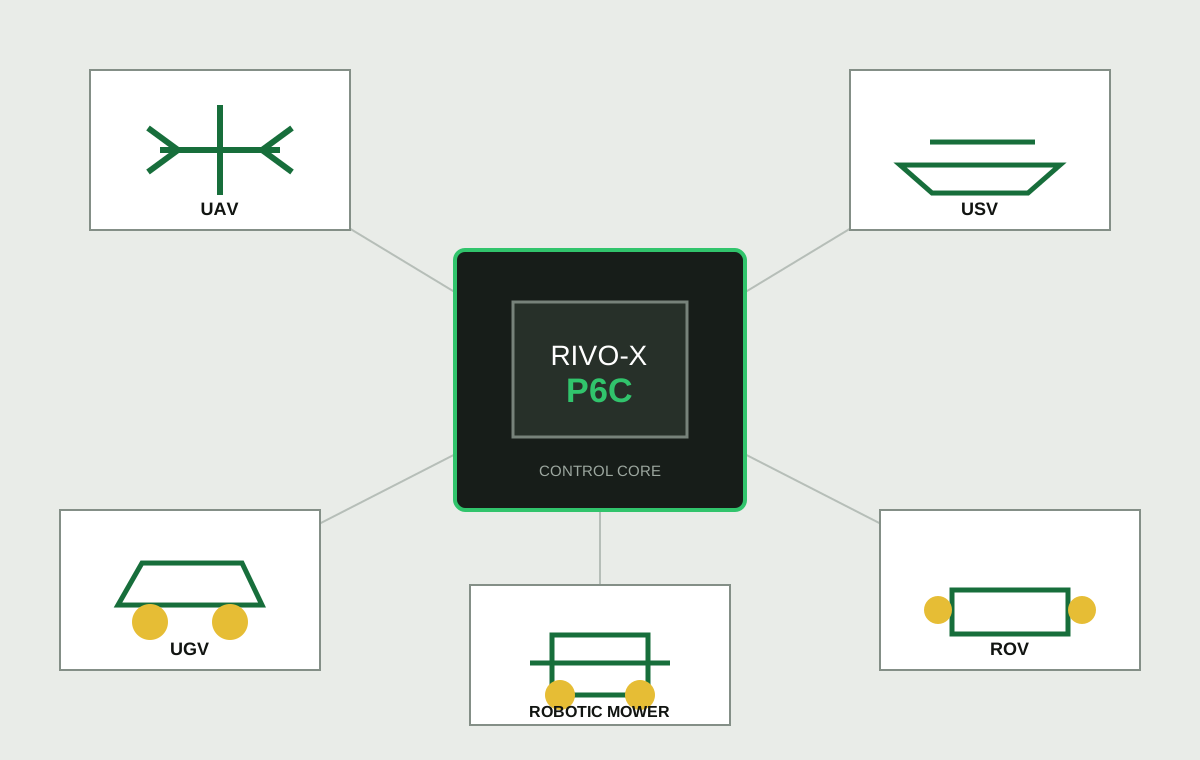
PWM, CAN, GNSS, telemetry, redundant sensing, and vibration isolation provide a common control foundation across multiple vehicle domains.
Explore applicationsRivo-X P6C Support
Review the current technical PDF, verified specifications, and the status of upcoming engineering guides.
Complete the system